Cloud spotting for beginners: keep a daily cloud journal
Cloud spotting needs no equipment and no clear night. Look up once a day, put a name to what you see, and write it down. After a few weeks the ten cloud types stop being Latin words and start being things you recognize, and you begin to see the weather coming.
Why once a day works
Seeing a cloud once and reading its name rarely sticks. Naming the sky every day does, because the same few types keep coming back: puffy cumulus on sunny afternoons, a grey sheet of stratocumulus on dull mornings, wisps of cirrus high above. A short daily note also builds a record you can look back on, and that record is where the patterns show up: the thin veil that came a day before the rain, the heaps that grew tall before a shower.
What to write down each day
A notebook or the notes app on your phone is enough. Keep each entry short:
- Date and time. Morning and late-afternoon skies often look very different.
- The cloud. Its type, or your best guess. If you’re stuck, the three questions in “What cloud is this?” narrow it down to one or two.
- How much sky it covers, in eighths. Weather observers count cloud cover in oktas: 0/8 is a clear sky, 8/8 is completely overcast.
- What happened next. Rain within a few hours? Clearing by lunch? Add it later the same day. This is the line that teaches you the most.
- A photo, so you can check your guess again later.
A sample week
An example of what a few days of entries can look like. Read down the last column and you can see a classic sequence: high wisps, then a thickening veil, then a day of steady rain.
| Day | Time | Cloud | Sky covered | What happened next |
|---|---|---|---|---|
| Mon | 8:15 | Cumulus | 2/8 | Dry all day |
| Tue | 7:50 | Cirrus | 1/8 | Dry; a thin veil by evening |
| Wed | 8:05 | Cirrostratus, halo around the sun | 6/8 | Rain after dark |
| Thu | 8:20 | Nimbostratus | 8/8 | Steady rain until noon |
| Fri | 8:10 | Stratocumulus | 6/8 | Sunny spells by afternoon |
A thin, milky veil of cirrostratus, often with a halo, frequently arrives ahead of a warm front, with rain 12–24 hours later. Not every time, which is exactly why writing down what happened next is worth it.
The full sequence, and the other signs worth noting, are in clouds before rain.
A four-week plan for beginners
- Week 1: shapes only. Sort each sky into heaps, patches, sheets or wisps. Don’t worry about names yet.
- Week 2: add the height. Low, middle or high. For patchy clouds, hold your hand out at arm’s length: patches wider than three fingers are low, between one and three fingers are middle, and grains narrower than your little finger are high. Shape plus height gives you the name.
- Week 3: watch what follows. Fill in the last column every day. By the end of the week you’ll have your own first “this came before rain” entry.
- Week 4: one level deeper. Cloud types split into species. Cumulus alone has humilis (small and flat), mediocris (about as tall as it is wide) and congestus (taller than it is wide, often before showers). Try to tell them apart.
Tips for better cloud photos
- Never look straight at the sun, and don’t point your camera at it for long. Block it with a building or a tree, or face away from it.
- Include a little ground, a rooftop or the horizon. It shows how high and how big the cloud is.
- Get the whole cloud in if you can, then take a closer second shot.
- Shoot the same spot at the same time each day; the changes become easy to compare.
Let the app keep the log
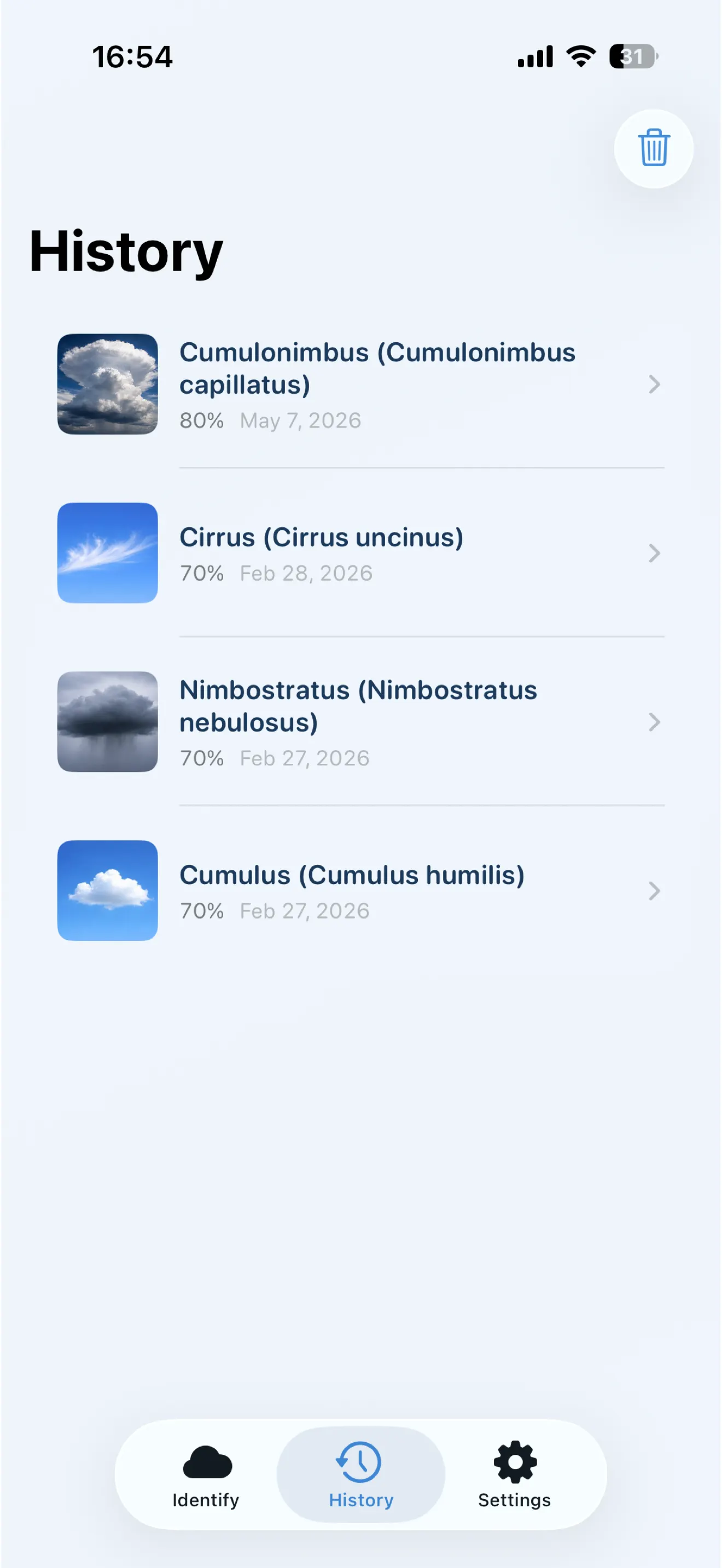
Cloud ID names the cloud from a photo of the sky, often down to the species, such as Cirrus uncinus or Cumulus humilis. Every identification is saved to your History automatically, with the photo, the name, the confidence score and the date, so the photos become your journal. Tap an entry to reopen the full result: the three ranked candidates, the reasons behind them and the weather insights.
It doesn’t know what the weather did next. Keep that line in your notebook, and the two together make a cloud journal that takes a minute a day.
Subscription app: weekly with a free trial when you’re eligible, or annual.